

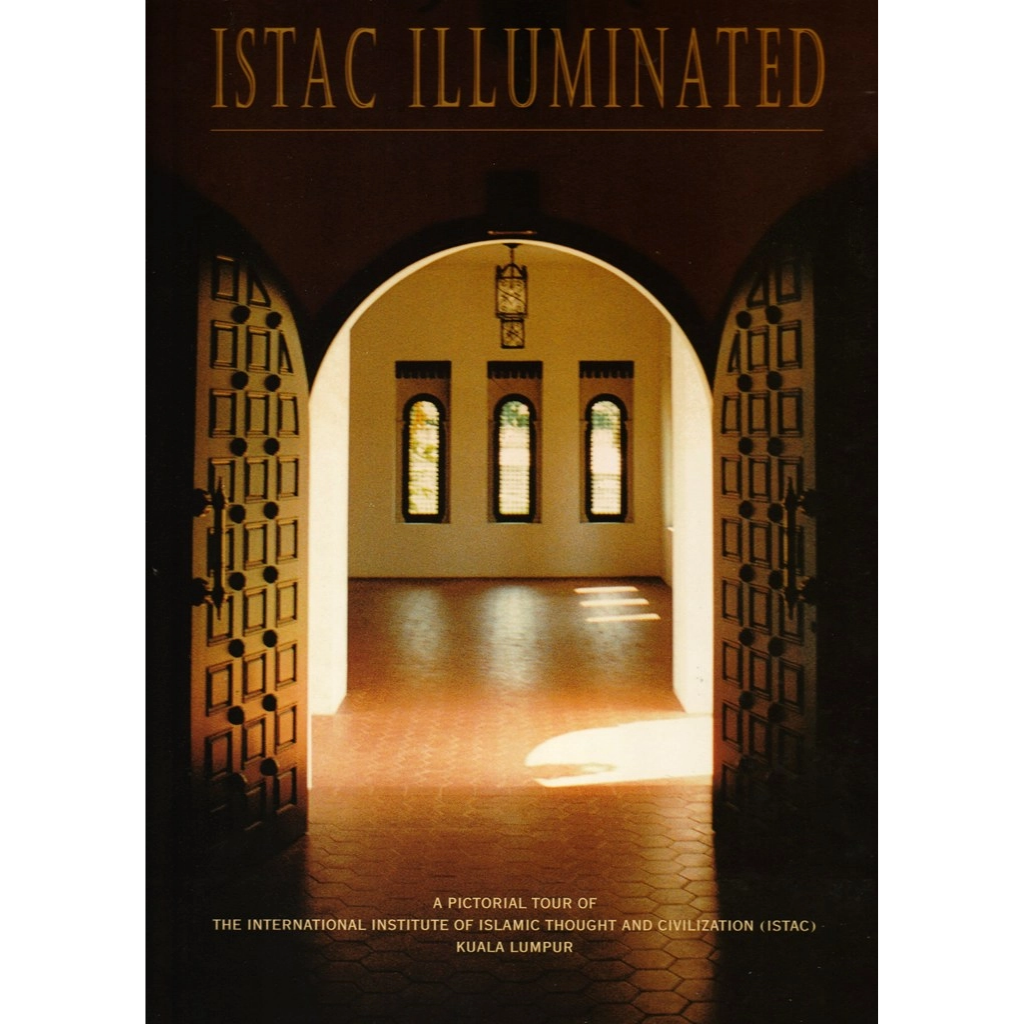
ISTAC Illuminated: A Pictorial Tour of the International Institute of Islamic Thought and Civilization
- Regular price
- RM 140.00
- Sale price
- RM 140.00
- Regular price
-
RM 140.00



Share
ISTAC Illuminated: A Pictorial Tour of the International Institute of Islamic Thought and Civilization (ISTAC), Kuala Lumpur - Hardback
Author: Sharifah Shifa al-Attas
Publisher: International Institute of Islamic Thought and Civilization (ISTAC)
ISBN: 9839379119
Year: 1998
Pages: 248pp
Weight: 2.1kg
Price: RM140
ISTAC Illuminated is a portrait and celebration of Kuala Lumpur’s International Institute of Islamic Thought and Civilization (ISTAC). Beginning with an examination of the philosophy and intentions of Founder-Director Professor Dr. Syed Muhammad Naquib al-Attas, and an account of the conception and founding of ISTAC, it then displays the physical fabric of the buildings, their exterior and interior, their setting and their furnishings. The book reveals also many of the manuscripts in ISTAC’s exceptionally important library and many historic and beautiful things in its collection of artefacts.
Officially opened in 1991 by Prime Minister Dato’ Seri Dr. Mahathir Mohamad, ISTAC was first conceived by Professor al-Attas in the 1970s when he began to present seminal ideas on Islamic education and the Islamization of knowledge. From this grew his idea of the nature of a true Islamic university, and ultimately, ISTAC. A postgraduate, research, and teaching institution, ISTAC offers degree courses at the Master’s and Ph.D. levels in three main streams of knowledge, namely Islamic Thought, Islamic Civilization, and Islamic Science. The Chairman of its Board of Governors is Dato’ Seri Anwar Ibrahim.
An important part of the book is devoted to ISTAC’s library, which contains over 110,000 volumes, plus over 6,000 manuscripts in microfilm, and another 2,000 or so in book form. Many are rare works; they include the earliest known Persian example of the first ever major work, 800 years old, on the mathematical sciences, that by the famous 10th-century Muslim astronomer al-Biruni. ISTAC also has unique manuscripts on algebra; Qur’ans from the courts of the Ottomans; also a 17th-century Malay Qur’an, possibly the oldest Malay Qur’an extant. Here also are very old works in Malay documenting the history of Islam in the Malay world; manuscripts on Sufi doctrine, bearing the seal of sultans; the famous Abdullah Munshi’s Hikayat Pelayaran Abdullah, and also another contemporary work by a Christian missionary, the Hikayat Binatang, the only work in Malay on natural history; beautiful miniatures depicting famous scenes from well-known allegorical love poems such as Yusuf and Zulaikha or Layla and Majnun and much more.
ISTAC has also acquired the entire private collections of distinguished scholars including Fazlur Rahman, Max Weisweiler, Bertold Spuler, Robert Brunschvig, Dietrich Brandenburg, and André and Oleg Grabar, the last-mentioned collection arguably the most authoritative in the world on Islamic architecture. The extensive grounds of ISTAC’s campus include, apart from the main building and library, a conference hall capable of seating over 300, with an adjoining mosque. The book illustrates the concept, design, architectural form, furniture, calligraphy, and all other decorative aspects of ISTAC’s buildings, all of which are the work of Professor al-Attas. His drawings and early rough sketches are here reproduced for the first time, together with over 200 photographs of ISTAC’s manuscripts, artefacts, and architectural features both exterior and interior.
This book will be treasured not only for its own qualities but as a kind of guided tour of ISTAC and all that it has to offer.